Oyo Watch: Will Teslim Folarin Forget Oyo APC Issues After Tinubu’s Appointment?

By Our Reporter
Politics is often a game of interests, expectations and calculations. In the All Progressives Congress (APC) in Oyo State, however, the biggest question at the moment is whether recent developments at the national level will finally change the political temperature within the party ahead of the 2027 governorship election.
For months, the Oyo APC has struggled with internal disagreements, particularly over the emergence of Senator Sharafadeen Alli as the party’s preferred candidate for the 2027 governorship election. The disagreement has not been merely about who occupies the ticket; it has also exposed deeper questions about inclusion, political structure, consultation and the distribution of influence within the party.
At the centre of much of this conversation has been Senator Teslim Folarin, the APC’s 2023 governorship candidate and a major political figure in Oyo State.
Folarin’s relevance to the Oyo APC cannot be reduced to his previous electoral performance. He has a political structure, loyalists and years of experience within the party. That is precisely why President Bola Tinubu’s intervention in the Oyo APC crisis has attracted considerable attention.
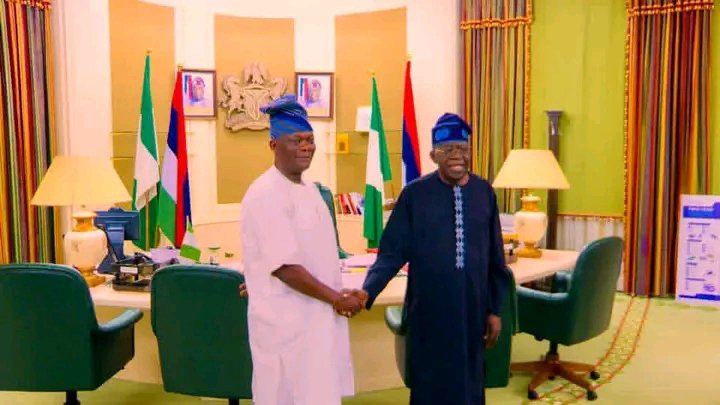
In July, Tinubu met with Folarin at the Presidential Villa in what was widely interpreted as an attempt to rally him behind Alli and help unite the party ahead of the 2027 election. Reports indicated that the meeting was part of broader efforts to resolve lingering disagreements within the Oyo APC.
That intervention was significant.
The President was, in effect, asking one of the party’s most influential Oyo politicians to put the larger interest of the APC ahead of his personal political calculations.
But politics is rarely that simple.
The appointment changes the equation
Now, with Folarin receiving a fresh appointment from President Tinubu, a new dimension has been introduced into the Oyo APC equation.
An appointment from the Presidency is not merely a political reward. In Nigeria’s political environment, it can also be interpreted as a signal of confidence, relevance and continued access to the centre of power.
For Folarin, therefore, the appointment potentially changes the dynamics of his relationship with the APC leadership in Oyo.
The question is whether the new responsibility will make him more willing to embrace the President’s position on the Oyo APC governorship structure—or whether the issues that existed before the appointment will remain unresolved.
This is where the real politics begins.
Folarin has already demonstrated that he is capable of playing a central role in the party’s mobilisation efforts. Earlier in the year, he charged APC grassroots coordinators to work with existing party structures and emphasised the importance of internal cohesion ahead of 2027.
But reconciliation is different from mobilisation.
You can ask a politician to campaign for a candidate. It is considerably more difficult to convince his political family that their concerns have genuinely been addressed.
Can an appointment replace reconciliation?
This is perhaps the most important question facing the Oyo APC.
There is a tendency in Nigerian politics to assume that once a prominent politician receives an appointment, political disagreements automatically disappear.
They do not.
An appointment can create goodwill. It can strengthen relationships. It can open new channels of communication. But it does not necessarily erase grievances or answer questions about fairness within a political structure.
That distinction matters in Oyo.
The APC has publicly acknowledged that reconciliation remains necessary. In August, Folarin and several other major aspirants were absent when the party’s reconciliation committee presented its findings to National Chairman Nentawe Yilwatda in Ibadan. Yilwatda subsequently described reconciliation as an ongoing process and said issues raised by aggrieved members would be addressed.
That development should not be ignored.
If the reconciliation process is still ongoing, then the appointment of Folarin does not automatically mean that the Oyo APC crisis has ended.
Rather, it could provide a new opportunity to resolve it.
And then there is Senator Alli
For Senator Sharafadeen Alli, the situation is equally delicate.
The senator has been positioned at the centre of the APC’s 2027 governorship calculations. Earlier reports indicated that party stakeholders were considering him as the preferred or consensus candidate for Oyo.
Alli himself has also spoken about reconciliation efforts, including the involvement of Folarin in attempts to bring aggrieved members together.
But winning an election is different from securing a party ticket.
A candidate needs more than the endorsement of party leaders. He needs structures, loyalists, local influencers, ward-level mobilisation and, most importantly, the willingness of competing political blocs to work for a common objective.
That is why Folarin remains important to Alli’s political project.
The former governor candidate does not necessarily have to be the candidate to remain politically consequential. His ability to influence supporters and political actors across Oyo makes his cooperation valuable to whoever flies the APC flag in 2027.
And this is where the President’s latest move becomes politically interesting.
Will Folarin put Oyo APC first?
The appointment may have strengthened Folarin’s relationship with the Presidency, but the bigger test is what happens in Oyo.
Will he now completely embrace Alli?
Will he campaign for him?
Will his political structure work for the APC governorship candidate?
Will he ask his supporters to close ranks?
Or will he insist that the issues that caused dissatisfaction within the party must first be addressed before genuine reconciliation can take place?
None of these questions should be dismissed as personal politics.
They go to the heart of whether the APC can build a united opposition against the Peoples Democratic Party (PDP), which has controlled Oyo State since 2019.
The APC cannot afford to enter 2027 with a divided house.
The party’s challenge is therefore bigger than Folarin and Alli. It is about whether the various political tendencies within the party can sacrifice individual ambitions for a collective objective.
Folarin’s dilemma
For Folarin, there is also a political calculation to make.
He has been a major player in Oyo politics for years. His political relevance is not dependent solely on holding an elective office. But remaining influential also requires maintaining relationships with the Presidency, the state party structure and his supporters.
The new appointment could therefore place him at an interesting crossroads.
He can choose to become one of the strongest forces behind the reconciliation of the Oyo APC, using his renewed access to the Presidency to bring different camps together.
Or he can maintain his reservations and continue to demand answers to the issues that have divided the party.
The first option could make him a major architect of the APC’s 2027 campaign in Oyo.
The second could preserve his political independence but make the party’s path to reconciliation more complicated.
Either way, his next move will matter.
The bigger question
The APC has enough politicians in Oyo State.
What it needs now is political cohesion.
The party needs to move beyond meetings, endorsements, photographs and statements about reconciliation. It needs a structure in which major stakeholders genuinely believe they have a place.
That includes Folarin, Alli, Adebayo Adelabu, Rauf Olaniyan, Akeem Agbaje, Hakeem Alao and the numerous other political actors whose influence could determine how the 2027 contest unfolds.
The fact that the reconciliation process remains active shows that the problem has not disappeared.
But Folarin’s new appointment could become either a turning point or simply another chapter in the long-running Oyo APC political drama.
For now, the question is no longer whether President Tinubu wants Folarin to support the APC’s project in Oyo. The President’s intervention has already provided a strong indication of that.
The question is whether Folarin, having received a fresh vote of confidence from the President, will now put aside whatever reservations he may still have and fully embrace the project of rebuilding the Oyo APC behind Senator Sharafadeen Alli.
That question is left for Senator Sharafadeen Alli to answer: has the APC truly resolved the issues that could make Teslim Folarin and his political family fully commit to the 2027 project, or is the party simply hoping that Tinubu’s appointment will make the unresolved questions disappear?