

By Our Reporter
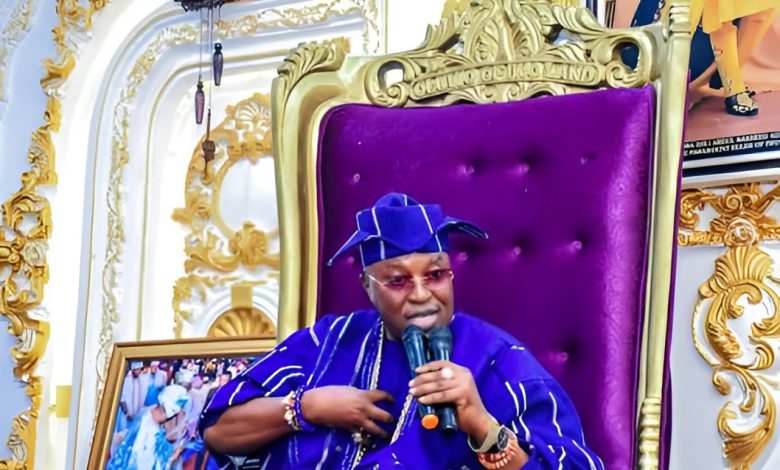
The Oluwo of Iwo, Oba Abdulrasheed Akanbi, has announced a ban on the presentation and consumption of Hennessy and other alcoholic beverages within his palace, describing such drinks as harmful to human health and warning visitors against bringing them as gifts.
The monarch made the declaration in a video shared on his official Facebook page on Tuesday, where he insisted that anyone bringing alcoholic drinks to the palace was indirectly wishing him harm.
According to the Oluwo, imported spirits such as Hennessy, gin and schnapps, which are often presented to traditional rulers and elders during visits, should no longer be brought to his palace because of their alleged adverse health effects.
“The so-called alcohol usually presented or reserved for the elders is detrimental to their health—it leads to death,” he said.
He warned that alcoholic beverages damage vital organs, particularly the kidneys, and argued that they should not form part of the gifts presented to traditional rulers.
“Anyone who brings hot drinks to the king’s palace wants to eliminate the king. Gin, schnapps reserved for the elderly should not be brought to my palace because what they call alcohol for the elderly is made by the Western people to kill and destroy internal organs. It will render the kidneys useless,” the monarch stated.
The traditional ruler disclosed that he recently learnt that some visitors had brought bottles of Hennessy to the palace, a development he strongly condemned.
“I heard you brought Hennessy; don’t bring it here. You want to kill me. Anyone who brings Hennessy or other dangerous alcoholic drinks has the intention to kill me. So, I should drink an entire bottle; what will I use to pray?” he queried.
Oba Akanbi further argued that alcohol consumption was not part of the original Yoruba cultural heritage, maintaining that the practice should not be associated with traditional institutions.
His remarks align with global public health warnings on alcohol consumption. The World Health Organisation (WHO) has consistently maintained that no level of alcohol consumption is completely safe for human health, citing increased risks of liver disease, certain cancers, cardiovascular diseases and other health complications.
Beyond the issue of alcohol, the Oluwo criticised some traditional practices in Yorubaland, particularly the use of canes and other weapons by masquerades to assault members of the public during festivals.
Describing the practice as violence rather than culture, he questioned why innocent residents should be subjected to attacks in the name of tradition.
“Are Yoruba cows? How can I be a king and people are being macheted in the streets? Are we butchers?” he asked.
The monarch also faulted the movement restrictions often imposed during the Oro festival, arguing that preventing residents—especially women—from moving freely is unconstitutional and contrary to fundamental human rights.
“We restrict people’s movement; even the president cannot do that. It is unconstitutional. It is illegal,” he said.
Since ascending the throne of Iwo in 2016, Oba Abdulrasheed Akanbi has remained one of Nigeria’s most outspoken traditional rulers, frequently challenging long-held cultural practices and calling for reforms within traditional institutions.
His views have often generated controversy and placed him at odds with some traditional and religious leaders. In one of such disputes, the Osun State Council of Traditional Rulers announced his suspension over alleged misconduct, a decision the Oluwo dismissed as “a mere audio pronouncement.