Two Weeks After Tinubu’s Reconciliation Push, Oyo APC Crisis Lingers as Alli Names Campaign DG

By Our Reporter
Two weeks after President Bola Tinubu reportedly tasked former Senate Leader, Senator Teslim Folarin, with reconciling aggrieved members of the All Progressives Congress (APC) in Oyo State, questions are mounting over whether the presidential intervention has translated into a concrete settlement of the party’s internal crisis.
The development comes as the party’s 2027 governorship candidate, Senator Sharafadeen Abiodun Alli, has moved ahead with the formation of his campaign structure, appointing former Akinyele Local Government chairman, Barrister Yemi Aderibigbe, as Director-General of his campaign council.
Aderibigbe’s appointment was announced on July 28, barely days after the two-week period reportedly given by President Tinubu for significant progress in the reconciliation process.
The appointment is significant because Aderibigbe served as Deputy Director-General of the APC’s 2023 governorship campaign, when Folarin was the party’s candidate. However, the latest campaign structure has so far not publicly reflected a broad-based accommodation of the prominent politicians and aspirants who had expressed grievances over the process that produced Alli as the party’s candidate.
Tinubu’s intervention
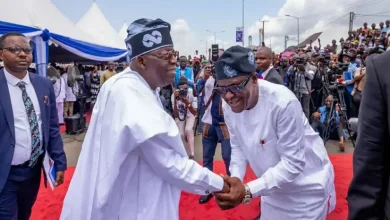
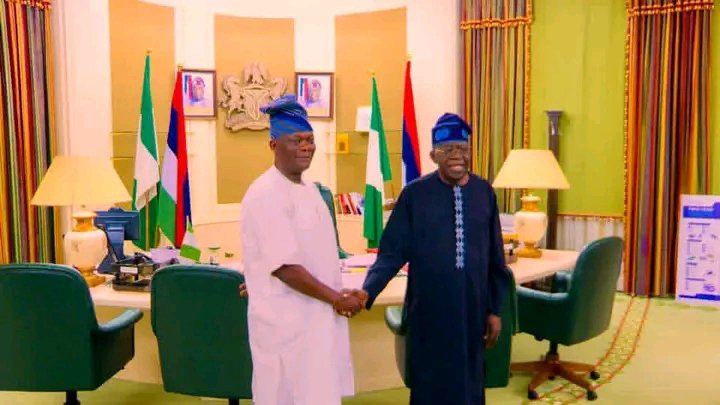
The reconciliation effort followed a meeting between President Tinubu and Folarin at the Presidential Villa in Abuja in July.
According to reports, the meeting was aimed at rallying Folarin behind Alli and resolving the lingering disagreements within the Oyo APC ahead of the 2027 governorship election.
The Nigeria Times had reported that Tinubu tasked Folarin with spearheading efforts to reconcile aggrieved stakeholders and unite the party behind Alli.
Sources cited in the report said the President wanted Folarin to engage protesting stakeholders and work towards ensuring that the party entered the 2027 election as a united family.
Tinubu was also said to have expressed confidence that significant progress would be achieved within two weeks. (The Nigeria Times)
The intervention followed months of tension within the Oyo APC after Alli emerged as the party’s governorship candidate.
Some of the aggrieved politicians had questioned the process that produced Alli, while various groups within the party continued to demand reconciliation and a fair distribution of political opportunities.
Two weeks later, what has changed?
With the two-week window now elapsed, there has been no publicly announced comprehensive settlement involving all the major aggrieved stakeholders.
Instead, Alli has proceeded with the construction of his campaign machinery.
On July 28, he appointed Aderibigbe as Director-General of his campaign council, describing him as a grassroots politician with experience in party organisation, public administration and mobilisation.
Aderibigbe previously served as chairman of Akinyele Local Government between 2008 and 2011 and later held government positions under former Governor Abiola Ajimobi and Governor Seyi Makinde.
He also played a role in the APC’s 2023 governorship campaign, serving as Deputy Director-General when Folarin was the party’s flag bearer.
The appointment therefore places a figure with previous experience in Folarin’s 2023 campaign at the centre of Alli’s emerging political structure.
However, the appointment has also brought renewed attention to the unresolved question of how the major aggrieved camps will be accommodated in Alli’s campaign.
While there is no evidence that Alli has formally shut the door on the aggrieved stakeholders, their absence from the first major campaign appointment has raised questions about whether the reconciliation process has moved beyond meetings and assurances to actual political integration.
Alli says reconciliation is ongoing
Alli has, however, insisted that efforts to reconcile the aggrieved members are continuing.
Speaking at a programme tagged “A Day With BSA” at the Nigeria Union of Journalists Press Centre in Ibadan on August 3, Alli said he had met with former governorship aspirants, members of the G-6 bloc and other influential party leaders as part of efforts to resolve the crisis.
He also acknowledged Tinubu’s intervention, saying the President had engaged Folarin and tasked him with reconciling aggrieved members.
“We have been making conscious efforts to unite the APC. I have met with aspirants and spoken with members of the G-6. President Bola Tinubu has also engaged Senator Teslim Folarin and tasked him with reconciling all aggrieved members,” Alli said.
He added that the crisis was already being resolved and expressed confidence that the party would emerge stronger and more united.
The statement indicates that the reconciliation process has not been abandoned, but it also suggests that the exercise remains ongoing despite the two-week period earlier associated with the presidential intervention.
Folarin remains central to the equation
Folarin remains one of the most important figures in the reconciliation equation because of his political influence and his status as the APC’s 2023 governorship candidate.
Before his meeting with Tinubu, Folarin had hosted former Minister of Power Adebayo Adelabu, former Deputy Governor Rauf Olaniyan and Senator Fatai Buhari.
The meeting generated considerable political interest after the group resolved to support Tinubu’s 2027 presidential bid but did not publicly commit itself to a particular candidate in the Oyo governorship race.
That position fuelled speculation over whether Folarin and other influential APC figures were prepared to immediately align with Alli.
The presidential intervention subsequently appeared designed to prevent such divisions from damaging the APC’s chances of reclaiming Oyo State from the Peoples Democratic Party (PDP).
New campaign structure tests reconciliation
Alli’s decision to begin building his campaign structure now provides a practical test of the reconciliation process.
Political reconciliation in a major party such as the APC is not only measured by public statements or meetings. It is also reflected in the distribution of responsibilities, campaign positions and political recognition among competing blocs.
The emergence of Aderibigbe as campaign DG could therefore be viewed as an early indication of how Alli intends to structure his campaign.
Aderibigbe’s previous role in Folarin’s 2023 campaign gives him a connection to the former governorship candidate’s political structure. But unless other prominent members of the aggrieved camps are subsequently brought into the campaign, questions about inclusiveness are likely to persist.
This is particularly important because the APC is attempting to avoid the kind of internal division that contributed to its defeat in the 2019 and 2023 governorship elections.
Warning signs from within the party
The continued emphasis on reconciliation by senior APC figures also suggests that the party recognises the seriousness of its internal divisions.
Professor Adeniyi Olowofela recently warned that the Oyo APC must reconcile its differences or risk another defeat in 2027.
Olowofela urged party leaders and members to put their differences aside and unite behind the party’s governorship candidate.
His warning came against the backdrop of the same internal disagreements that prompted the intervention by the Presidency.
For the APC, the challenge is therefore no longer simply producing a candidate. Alli has already emerged as the party’s flag bearer. The bigger challenge is ensuring that the political machinery behind him includes enough of the party’s competing interests to prevent internal grievances from weakening the campaign.
The bigger question
The key question now is whether the two-week reconciliation assignment has produced a political settlement or merely created additional time for negotiations.
While Alli says discussions with aggrieved aspirants and stakeholders are ongoing, there has yet to be a widely publicised reconciliation event involving all the major blocs.
Similarly, the emergence of a campaign DG without an immediately visible representation of some of the aggrieved camps has created another test for the party’s unity project.
This does not necessarily mean that the reconciliation effort has collapsed.
Rather, it shows that the process remains incomplete.
With the 2027 governorship election still months away, the APC has time to bring more stakeholders into Alli’s campaign structure. But the longer the grievances remain unresolved, the greater the possibility that the party’s internal divisions could become an electoral liability.
For Tinubu’s intervention to achieve its intended political objective, the reconciliation will ultimately have to move beyond private meetings and assurances to a visible arrangement in which the major factions believe they have a stake in the campaign.
For now, the appointment of Alli’s campaign DG marks the beginning of the next phase of the Oyo APC race — but it also leaves unanswered the question that followed Tinubu’s intervention two weeks ago:
Has the Oyo APC truly reconciled, or is the party merely moving ahead with its campaign while the underlying grievances remain unresolved?