2027 Elections: Akpabio Laments Shortage of Private Jets for Political Campaigns

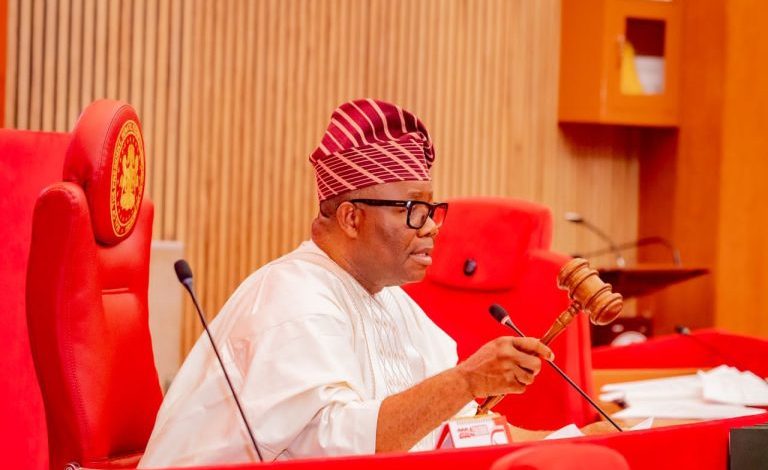
Senate President Godswill Akpabio has disclosed that politicians preparing for the 2027 general elections are struggling to secure private jets for their campaign activities, blaming the situation on the limited capacity of Nigeria’s aviation sector.
Akpabio made the disclosure on Tuesday during plenary at the National Assembly while lawmakers deliberated on a motion seeking the enforcement and renegotiation of Nigeria’s Bilateral Air Services Agreement (BASA) with China.
The Senate President said the growing demand for air transportation, particularly as political activities gather momentum ahead of the 2027 general elections, has made it increasingly difficult for politicians to hire private aircraft for their movements across the country.
Expressing concern over the situation, Akpabio warned that the pressure on domestic aviation operators could become more pronounced during the December festive season, when demand for air travel traditionally increases.
“Watch December and the confusion. Even the private airlines cannot handle it. Common campaigns, we cannot see even private jets to hire,” he said.
He urged the Federal Government to consider interventions that would address the challenges confronting domestic airlines and improve the country’s aviation capacity.
Akpabio also called for the revival of a national carrier, arguing that Nigeria needs a government-backed airline capable of representing the country internationally and strengthening its aviation industry.
Recalling the operations of the defunct Nigerian Airways, the Senate President said the former national carrier once operated between 32 and 40 aircraft, connecting Nigeria to several destinations.
He specifically recalled the airline’s role in transporting Nigerian pilgrims to Saudi Arabia, questioning how the country moved from having such an aviation capacity to its present situation.
“We used to have a plane in those days carrying people to Saudi Arabia and all that. At the time, Nigerian Airways had about 32 planes on ground, about 40, going from one place to the other. So, how did we get here?” he asked.
The Senate President maintained that Nigeria should have a functional national airline that would carry the country’s flag and contribute to the development of the aviation sector.
The discussion followed a motion sponsored by Senator Tahir Monguno, representing Borno North, seeking a review of the Bilateral Air Services Agreement between Nigeria and China to allow Nigerian airlines to operate direct flights to the Asian country.
Monguno argued that direct air connectivity between both countries would reduce travel time, improve supply-chain efficiency, strengthen trade relations and limit foreign exchange outflows associated with international air travel.
Senator Abdul Ningi, representing Bauchi Central, also raised concerns about Nigeria’s relationship with China, arguing that the country was not deriving commensurate benefits from its engagement with the Asian economic powerhouse.
Following deliberations, the Senate urged the Ministry of Aviation to renegotiate the agreement to establish direct commercial air links between Nigeria and China.
Private jet usage ahead of 2027
Akpabio’s remarks have also drawn attention to the growing reliance on private aircraft by politicians during election campaigns, particularly presidential candidates and senior political figures who often travel across several states to attend rallies, meetings and other campaign engagements.
Chartered private aircraft are frequently used by political leaders to navigate demanding campaign schedules, although the cost of hiring such aircraft varies according to aircraft type, distance, capacity and duration of travel.
With the 2027 general elections approaching, the Senate President’s comments have highlighted the aviation demands associated with Nigeria’s political activities, alongside broader questions about the capacity of domestic airlines and the future of a national carrier.
His call for the revival of Nigerian Airways has consequently brought renewed attention to the country’s long-running debate over establishing a sustainable national airline.